

Every day, thousands of aircraft cross the world’s skies guided by a continuous stream of voice communications. Air traffic controllers and pilots depend on those transmissions being clear, immediate, and intelligible. When voice quality degrades, even marginally, the consequences can be serious. That’s why the Mean Opinion Score, originally a metric from the telco industry, has taken on new urgency in air traffic control (ATC) environments undergoing the shift to Voice over IP (VoIP).
This article walks through what MOS means in an ATC context, why measuring it is more complex than in standard telephony, which regulatory standards define the requirements, and the tools and methods available to maintain voice quality where it needs to be.
From Telephony to the Skies: What MOS Actually Measures
Mean Opinion Score (MOS) is a standardized scale for rating perceived voice quality. It ranges from 1 to 5, where 1 indicates unintelligible audio, and 5 indicates perfect clarity. Originally defined in the telecom world, it was designed to reflect what a human listener actually hears, not just what the network statistics suggest.
The traditional approach, defined in ITU-T P.800, involves collecting ratings from actual human listeners across many test calls and averaging the results. In practice, that subjective process isn’t viable for an operational ATC environment. You can’t rely on controllers to file voice quality complaints as your primary quality measurement mechanism.
Automated methods have therefore replaced manual scoring. The two main approaches, active testing and passive monitoring, each estimate MOS using objective algorithms, allowing continuous oversight without relying on human feedback.
Why the TDM-to-IP Migration Makes Voice Quality Harder to Guarantee
Legacy ATC communication ran on Time Division Multiplexing (TDM), circuit-switched networks that dedicated a fixed path to each call. Within that model, voice quality was stable and predictable: once a circuit was established, it stayed consistent regardless of other network activity.
IP-based networks work differently. Packet switching means that voice data shares the same infrastructure as other services, competes for bandwidth, and is subject to variable routing decisions. Key issues that affect MOS on IP networks include:
- Packet loss: Even two lost packets in a five-second window can push MOS below the 4.0 threshold required by ATC standards
- Jitter: Variations in packet arrival time that disrupt the smooth playback of audio
- Increased network complexity: Software updates, load variations, and dynamic routing all introduce new points of failure
- Shared infrastructure: Multiple services competing for the same network resources
While these challenges exist in commercial VoIP as well, the stakes in ATC are fundamentally different. A voice quality issue that causes frustration on a customer service call becomes a safety concern when it affects a controller managing inbound traffic.
The ATC Communication Model: Why PTT Changes Everything
Standard telephony involves continuous, bidirectional audio throughout a call. ATC communications follow a completely different pattern, based on Push-to-Talk (PTT). Controllers activate their microphone to transmit, which simultaneously blocks the channel, making it a one-directional exchange until they release the button. Exchanges are brief, coded, and structured around brevity by design.
This creates a real challenge for MOS measurement. The ITU standard (ITU-T P.800) specifies that MOS should be evaluated based on voice snippets of approximately 8 seconds. In telephony, collecting 8 seconds of continuous speech is trivial. In ATC, a single transmission might last 2 or 3 seconds. Passive monitoring systems, therefore, need to aggregate multiple PTT events before they have enough audio to calculate a statistically meaningful MOS value.
And when no one is transmitting at all? Traditional MOS measurement simply can’t apply. Yet the network is still running. And still subject to degradation. That gap is addressed by a concept covered later in this article.
The Regulatory Framework: EUROCAE ED-Standards
The European Organisation for the Safety of Air Navigation’s working group (EUROCAE WG-67) has developed a suite of standards governing IP-based ATC communication. Four standards are central to understanding the MOS requirements:
- ED-136. Operational and technical requirements for IP-based ATC communication systems
- ED-137. Interoperability protocols for ATC VoIP components
- ED-138. Network performance requirements for VoIP in air traffic management
- ED-139. Qualification testing procedures for ATC VoIP systems and components
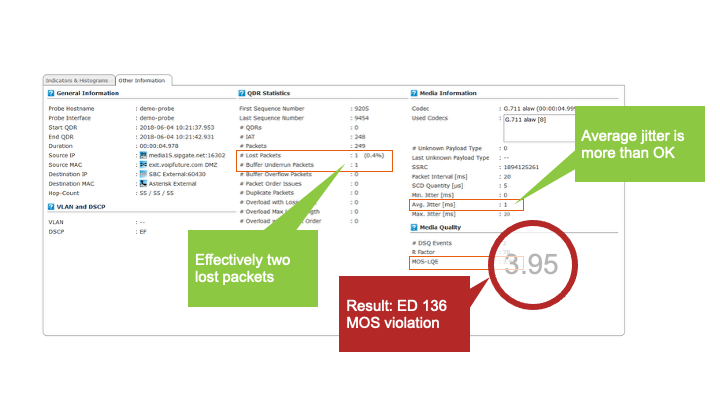
The voice quality requirement sits in ED-136, Chapter 6.3.1, which states that systems shall achieve a MOS greater than 4.0 for all air-ground and ground-ground communications. This is a stringent threshold, and as shown by real monitoring data, even two dropped packets within a five-second RTP stream can produce a MOS of 3.95, falling below compliance.
Two important tensions exist within the standard. First, ED-137 explicitly permits codecs G.728 and G.729, but neither can achieve a MOS above 4.0 even under ideal network conditions. Any Air Navigation Service Provider (ANSP) using these codecs is technically in conflict with the ED-136 quality requirement. Second, ED-136 does not clearly define whether the MOS threshold applies to the end-to-end mouth-to-ear path, or only to the VoIP packet transport layer. This distinction matters because analog radio links between controllers and pilots frequently produce audio quality below 4.0, and IP transport issues compound whatever quality the radio path delivers.
Active Testing vs. Passive Monitoring: Two Paths to MOS Measurement
Both approaches estimate MOS automatically, but they do it very differently, and they serve different purposes.
Active Testing
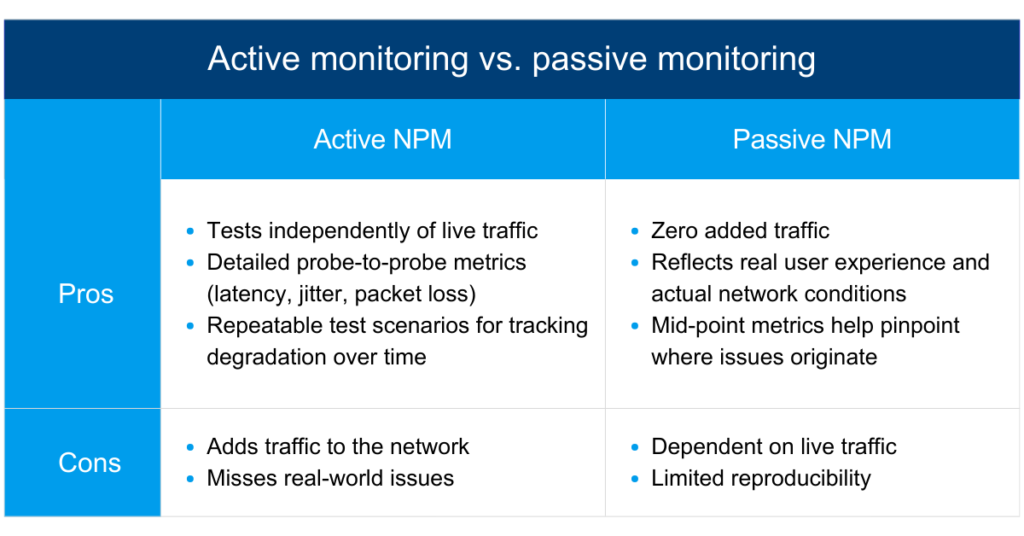
Active testing injects known synthetic speech samples into the network and compares the received signal to the original. The most widely used standard for this is ITU-T P.863 (POLQA). Because the test signal is controlled and known in advance, active testing can deliver highly precise results: not just MOS, but specific measurements of jitter, packet loss, duplicate packets, and end-to-end latency. It confirms that the full communication path, from Controller Working Position (CWP) through the network to remote radio sites, is performing within specification at the time of the test. The downside is that active testing is intrusive, consumes network resources, doesn’t reflect actual traffic conditions, and gives no insight into how actual user devices behave in practice.
Passive Monitoring
Passive monitoring analyzes real-life traffic without injecting anything into the network. It captures actual call data, codec usage, jitter, packet loss, and uses that information to estimate MOS in near real-time, based on the ITU-T G.107 E-model. Because measurements happen across multiple points in the network simultaneously, it’s possible to pinpoint exactly where quality is degrading, rather than simply detecting that something is wrong somewhere. Passive monitoring captures actual user device behavior and real call paths, providing continuous visibility. For ATC, where issues need to be caught before they affect safety-critical communications, this real-time visibility is what makes passive monitoring indispensable.
At a glance:
Active testing strengths: precise end-to-end measurement, controlled conditions, service availability insights
Active testing limitations: artificial traffic only, intrusive, consumes resources, no device-level visibility
Passive monitoring strengths: continuous analysis of real traffic, reflects actual controller experience, pinpoints problem location
Passive monitoring limitations: only implicit service availability data, issues not always reproducible, approximate end-to-end view
The two approaches are complementary, not competing. But for real-time safety assurance in ATC, passive monitoring needs to be the foundation, with active testing as a supplement for targeted investigations.
Solving the Idle Channel Problem: Expected MOS (eMOS)
ATC channels are active only a fraction of the time. Between transmissions, endpoints send R2S (Radio-to-Switch) packets every 200 milliseconds, far less frequently than voice packets, which arrive every 20 milliseconds. R2S packets serve as a keep-alive mechanism, carrying information on signal strength, noise levels, and timing data. Losing the occasional R2S packet has no direct operational impact.
But those packets reveal something important: they tell you how the network is performing right now, when no one is talking. If R2S packets experience jitter or loss, what would voice quality be like if someone were to transmit at that moment?
By treating R2S keep-alive packets as if they were voice packets, eMOS continuously estimates the MOS during idle periods, bridging the gap between PTT transmissions and enabling truly uninterrupted quality monitoring across the full operational timeline.
The Bottom Line: Proactive Monitoring Is Not Optional
Voice is inherently sensitive to the characteristics of packet-switched networks. Latency and packet integrity issues that are merely inconvenient in consumer applications are safety-relevant in ATC. The MOS requirement of greater than 4.0 under ED-136 is not a nice-to-have. It is an obligation on ANSPs to demonstrate.
Waiting for controllers to report audio problems is not a monitoring strategy. Neither is relying solely on periodic active test calls. A passive monitoring system that continuously tracks MOS, including during idle periods via eMOS, provides the infrastructure that allows ANSPs to catch degradation before it becomes a safety event and to respond to regulatory requests for ED-136 compliance evidence without scrambling.
The telecom industry learned this lesson during its own IP migration. The ATC sector is navigating the same transition now, but with higher stakes. MOS is the metric that keeps that transition honest, and passive monitoring is the mechanism that makes it actionable.